Signs for Elderly to Use Walker

PawPaw has a walker. It lives near the bedroom door. Most mornings he walks past it on his way to the kitchen, navigating the hallway on his own terms, using the wall and doorframes and whatever faith twenty years of Parkinson's has left him. He knows the walker is there. He chooses not to use it.
I tell you this so you understand that "time to use a walker" and "actually using the walker" are two different problems. Here is how to identify the first one clearly.
The clearest physical signs
Struggling to stand from seated
When getting up from a chair requires visible effort — pushing off the armrests with both arms, rocking to build momentum, needing multiple attempts — leg strength has declined to a point where a walker provides meaningful support during the transition to standing. The walker gives them a stable frame to push against, which is often more useful than the chair arm they're already using.
Unsteady or shuffling gait
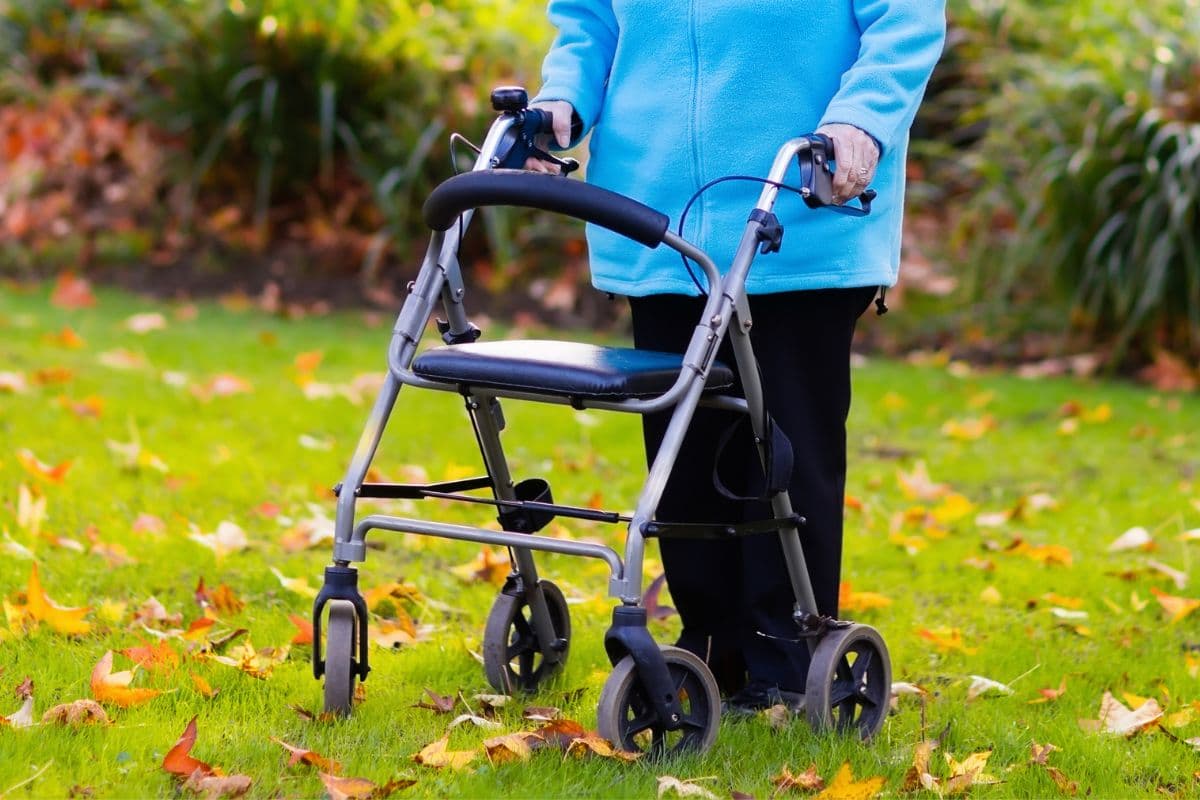
A gait that has become noticeably unsteady, shuffling, or slow — particularly with Parkinson's, stroke recovery, or general deconditioning — means each step carries more fall risk than it used to. For Parkinson's specifically, research shows that rollator walkers (four wheels with hand brakes) are generally better than standard pick-up walkers, because standard walkers can actually increase freezing episodes. Get the right type, not just any walker.
A fall, or near-miss falls
One fall is a data point. A pattern of near-misses — catching themselves on furniture, grabbing walls, stumbling and recovering — is a series of data points saying the same thing. A walker introduces a stable frame that moves with the person, replacing the ad hoc wall-grabbing with something far more reliable.
Fatigue over short distances
If walking from the bedroom to the kitchen is effort, or if a parent stops frequently to rest, a rollator walker with a built-in seat addresses this directly — walk when you can, rest when you need to, continue. This often extends the distance a person can cover and keeps them mobile longer.
Behavioral signs families often miss
They've stopped going places
A parent who has quietly stopped going to church, to the grocery store, to family events — not because they don't want to go but because walking through a parking lot or crowded space has become too difficult — is a candidate for a walker. The withdrawal pattern is the sign.
They're holding onto everything
A parent who moves through the house using walls, doorframes, countertops, and chair backs as a continuous support system is already doing what a walker does — but less safely. They've identified the need. The walker formalizes and improves what they're already doing.
Getting the right walker
Get a physical therapist to do the fitting. Height adjustment matters — a walker set too low causes hunching, creating back pain. The right height has the elbows at a 15-degree bend with shoulders relaxed. The type matters too: standard walkers for maximum stability; rollators for distance, rest capability, or Parkinson's. A PT fitting takes twenty minutes and prevents months of wrong-tool problems.
Chip Mitchell spent over 10 years owning and operating a home care company in Northwest Georgia. He currently cares for his father-in-law, PawPaw, who has lived with Parkinson's Disease for 20 years.

About Chip Mitchell
Chip Mitchell is the founder of Growing Gray USA. With over a decade of experience owning a home care company, he has helped hundreds of families navigate the complexities of caring for aging parents.
Read full bio →